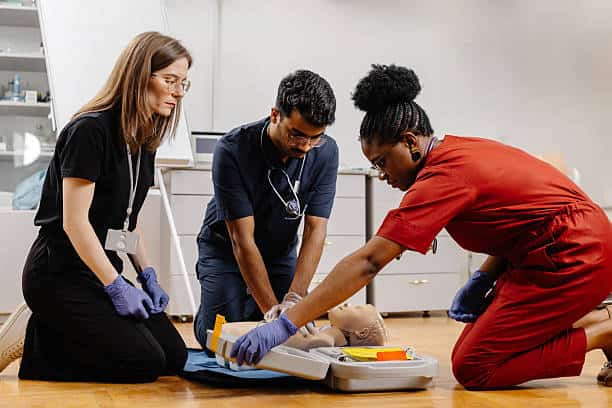
If you are a Certified Nursing Assistant in California, you already know what patient care looks like from the inside. You have taken vital signs, helped patients with daily activities, and built the kind of bedside presence that textbooks alone cannot teach. Many CNAs reach a point where they want to do more — to assess, administer, and coordinate — and that is exactly the role of a Licensed Vocational Nurse.
The good news: your CNA experience is not just background. It is a genuine advantage when you apply to and study in a vocational nursing program. This guide walks through the full CNA-to-LVN transition in California — what changes, what stays the same, and how to get started.
What Changes When You Move from CNA to LVN?
As a CNA, your scope of practice focuses on basic care under the supervision of nurses and physicians: bathing, feeding, mobility assistance, and monitoring. As a Licensed Vocational Nurse in California, your scope expands significantly.
California LVNs can:
- Administer medications, including some IV medications under physician supervision
- Perform wound care, dressing changes, and catheter care
- Collect blood samples and perform basic lab draws
- Observe patients and report changes in condition to the RN or physician
- Develop and contribute to nursing care plans
- Provide patient and family education
- Supervise CNAs and other unlicensed assistive personnel
The jump in responsibility comes with a corresponding jump in compensation. California LVNs earn significantly more than CNAs, and the role provides a clear pathway to further advancement — including LVN-to-RN bridge programs for those who want to continue.
Does Your CNA Experience Count Toward LVN Admission?
This is one of the most common questions CNAs ask, and the honest answer is: it depends on the program.
CNA experience does not typically waive LVN program prerequisites or reduce your required clinical hours. California’s BVNPT (Board of Vocational Nursing and Psychiatric Technicians) sets minimum standards for approved LVN programs, including required program hours and clinical rotations that all students must complete regardless of prior healthcare experience.
However, your CNA experience gives you several real advantages:
- Familiarity with the clinical environment — hospitals, long-term care facilities, patient interactions — reduces the learning curve during rotations
- Basic care skills (vital signs, patient communication, sterile technique habits) are already embedded
- You understand healthcare hierarchy and how to work under supervision — a skill many first-time students still need to develop
- Some programs look favorably on healthcare experience during admissions, though requirements vary
When evaluating programs, ask each school directly whether CNA experience is considered during admissions review, and whether any coursework or clinical placements can be adjusted based on documented healthcare work history.
The Steps to Becoming an LVN in California as a CNA
Step 1: Research BVNPT-Approved LVN Programs
All LVN programs in California must be approved by the BVNPT. This is a non-negotiable requirement — only graduates of BVNPT-approved programs can sit for the NCLEX-PN licensing exam. A list of approved programs is available on the BVNPT website.
When comparing programs, consider location and schedule (full-time vs. part-time options matter if you are working as a CNA while studying), total program hours (California programs typically include 1,200 to 1,500+ combined hours), and clinical rotation placements in your area.
Step 2: Meet Admission Requirements
Requirements vary by program, but most BVNPT-approved LVN programs require:
- High school diploma or GED
- Minimum age of 17 at program start (age 18 in most programs)
- Background check and health clearance
- CPR certification (some programs accept proof of current CNA certification as equivalent for certain prerequisites)
- Transcripts from any previous schooling
If you hold an active California CNA certificate, include it in your application. Some programs treat active CNA certification as evidence that you can meet patient care competency requirements, which may strengthen your application.
Step 3: Complete the LVN Program
LVN programs in California are intensive, combining classroom instruction with clinical rotations across care settings. You will cover all eight NCLEX-PN content areas — medical-surgical nursing, maternal nursing, geriatric care, pharmacology, pediatrics, mental health, and more — through a combination of lectures, skills labs, and supervised clinical hours.
As a CNA, the clinical environment will feel familiar even as the responsibilities expand. You will shift from assisting nurses to becoming the nurse, which is a different level of accountability. The clinical judgment skills required by the Next Generation NCLEX are built progressively throughout the program — not just at the end.
Step 4: Apply for the NCLEX-PN Through BVNPT
Once you complete your program, your school submits your completion record to the BVNPT. You then apply for licensure through the BVNPT, pay the required fee, and register with Pearson VUE to schedule your NCLEX-PN exam.
The NCLEX-PN uses Computerized Adaptive Testing (CAT). The exam adapts to your performance in real time and ends when the system has enough data to determine your competency level — typically between 85 and 150 questions. Your CNA clinical background will have built some of the patient reasoning skills the exam measures, but thorough exam preparation through your program and independent study is still essential.
Step 5: Receive Your LVN License and Begin Working
After passing the NCLEX-PN, the BVNPT issues your California LVN license. You can then apply for positions as a Licensed Vocational Nurse across a range of healthcare settings — hospitals, long-term care facilities, physician offices, clinics, home health, and more.
How Long Does the CNA-to-LVN Transition Take?
Most full-time LVN programs in California run 12 to 18 months. Part-time or evening programs may take longer — typically 18 to 24 months — and are a common choice for CNAs who continue working while studying.
After program completion, add time for the BVNPT application processing and NCLEX-PN registration, which typically runs four to eight weeks. From your first day of LVN classes to receiving your license, plan for roughly 14 to 20 months total on a full-time track.
Salary: The Career and Compensation Leap
The wage difference between CNA and LVN is significant in California. CNAs in Los Angeles typically earn $18 to $24 per hour depending on setting and experience. California LVNs commonly earn $28 to $40 per hour, with higher rates in acute care and specialty settings.
Beyond hourly pay, LVN positions often come with benefits, shift differentials for evenings and weekends, and stronger job security as demand for vocational nurses in California continues to grow. California’s aging population and ongoing nursing shortage make LVN a long-term stable career choice.
For CNAs who want to continue advancing, California also has LVN-to-RN bridge programs. The LVN credential is a recognized step on the nursing career ladder, not a ceiling.
What CDI Offers CNAs Making the Transition
Career Development Institute (CDI) has been training vocational nursing students in Los Angeles for over 20 years. CDI’s BVNPT-approved LVN program is well suited for CNAs ready to advance for several reasons.
The clinical environment will not feel foreign — CDI’s curriculum includes over 1,500 combined program hours, with clinical rotations in real healthcare settings in the Los Angeles area. CNAs who already understand patient care, documentation culture, and working within care teams often find the transition to clinical nursing more intuitive than first-time students.
CDI’s program also embeds NCLEX-PN preparation throughout the curriculum, including practice with the NGN question formats that emphasize clinical judgment — exactly the kind of patient reasoning that experienced CNAs have already begun developing in the field.
If you are considering the transition, visit our CDI VN program to learn more and enroll at CDI to take the next step.
Frequently Asked Questions
Do I need to retake my CNA courses when I enroll in an LVN program?
No. Completing an LVN program replaces and supersedes CNA training. You will not repeat basic nursing assistant coursework — instead, you will build on that foundation with more advanced clinical content.
Can I keep working as a CNA while enrolled in an LVN program?
Many CNAs do work part-time during LVN programs, especially in evening or weekend programs. However, full-time LVN programs are intensive. It is worth discussing your schedule with each program you are considering before enrolling.
Is a California CNA certificate accepted in other states?
CNA certification is regulated at the state level, and reciprocity rules vary. If you are considering relocating, check with the receiving state’s nursing board before applying. The LVN license is also state-issued, though California LVNs can apply for licensure in other states through endorsement processes.
What is the BVNPT and why does it matter?
The California Board of Vocational Nursing and Psychiatric Technicians (BVNPT) approves all LVN programs in California and issues LVN licenses. Only graduates of BVNPT-approved programs can take the NCLEX-PN. Always verify a program’s BVNPT approval before enrolling.
What is an LVN-to-RN bridge program in California?
An LVN-to-RN bridge program allows licensed vocational nurses to advance to Registered Nurse status without starting a nursing degree from scratch. These programs credit your LVN training and experience toward the RN requirements. The LVN credential is a recognized first step toward RN licensure, not a permanent ceiling.
Ready to Make the Transition?
As a CNA, you have already chosen healthcare as your path. The transition to Licensed Vocational Nurse is a natural and well-documented step — one that expands your responsibilities, your impact on patients, and your earning potential.
CDI School of Nursing offers a BVNPT-approved LVN program in Los Angeles designed for serious students who are ready to commit to a clinical nursing career. Start your enrollment inquiry at enroll at CDI today.