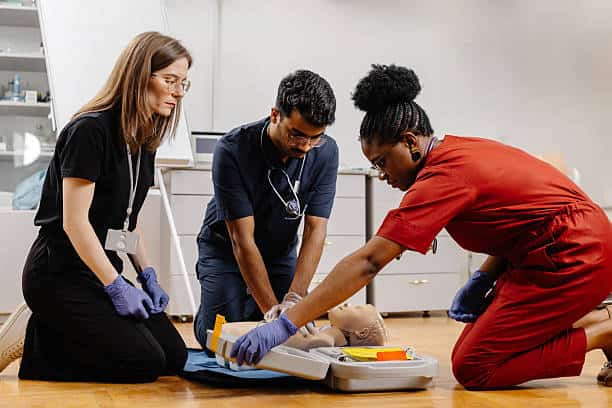
Clinical training is the part of LVN school that separates nursing education from other academic programs. You are not learning in a classroom about what nurses do. You are working alongside real nurses in real healthcare facilities, caring for actual patients under direct supervision. For most students, clinical rotations are the most challenging, most demanding, and most rewarding part of the program.
Before you enroll, it helps to understand exactly how clinical training works in California, what the BVNPT requires, what you will actually do in each rotation, and how the clinical experience you accumulate shapes the kind of nurse you become.
1. What California Requires for LVN Clinical Training
The California Board of Vocational Nursing and Psychiatric Technicians (BVNPT) sets minimum standards for all approved LVN programs in the state. BVNPT-approved programs must include a minimum of 1,500 combined program hours, covering both theory instruction and supervised clinical training.
The hours are not interchangeable. Theory hours build foundational knowledge. Skills lab hours develop clinical technique in a controlled setting. Clinical rotation hours place you in live patient care environments with real consequences and real responsibility.
A 12-month LVN program might structure those hours as approximately 576 classroom and lab hours plus 954 or more clinical hours. The exact breakdown varies by program, but all BVNPT-approved programs must meet the minimum and must cover specific required clinical specialties.
2. Which Clinical Specialties Are Covered
California’s BVNPT requires that LVN clinical rotations cover specific nursing specialties. Every BVNPT-approved program must include supervised clinical experience in at least these areas:
Medical-Surgical Nursing
The largest rotation in most programs. You work on medical-surgical floors in hospitals or long-term care units, caring for patients recovering from surgery, managing chronic conditions, or receiving acute illness treatment. Procedures include medication administration, wound care, IV management where applicable, and patient education. This rotation builds the core procedural foundation that almost every subsequent LVN job requires.
Maternal and Newborn Nursing
You rotate through labor and delivery units, postpartum floors, and newborn nurseries. Procedures include monitoring fetal heart rates, assisting with postpartum care, performing newborn assessments, and supporting breastfeeding education. California’s LVN scope of practice includes maternal nursing, so this rotation is required, not optional.
Geriatric Nursing and Long-Term Care
Rotations in skilled nursing facilities or long-term care units, focused on residents with dementia, chronic illness, and post-acute rehabilitation needs. Most LVN graduates spend the majority of their early careers in SNF settings. The geriatric rotation builds specific competencies for this patient population and gives students direct experience in the environment where they are most likely to be hired.
Pediatric Nursing
Care of infants, children, and adolescents in inpatient or outpatient settings. Pediatric patients communicate differently and respond differently to medications and procedures than adults. This rotation builds a distinct clinical skill set, including age-appropriate patient communication and pediatric medication dosing awareness.
Mental Health Nursing
Rotations in behavioral health units or psychiatric facilities. You observe psychiatric assessments, participate in therapeutic group interactions, administer psychiatric medications, and learn de-escalation techniques. This rotation is directly relevant for LVNs who will work in correctional facilities, behavioral health settings, or hospital psychiatric units after graduation.
Some programs include additional rotations in surgical, emergency, or specialty outpatient settings that expand clinical exposure beyond the required minimum. Ask specifically about which rotation sites a program uses before enrolling, because the quality and variety of sites directly affect what you learn.
3. What You Actually Do During a Clinical Rotation
Theory class teaches you how nursing procedures work. Skills lab lets you practice on mannequins and simulators. Clinical rotations are where you perform procedures on real patients.
On a typical clinical day, you arrive before shift handoff to review your assigned patient’s chart: diagnosis, current medications, recent vital signs, care plan, allergies, and physician orders. You attend the handoff report from the outgoing nurse, then take responsibility for your assigned patient under the supervision of a clinical instructor or preceptor.
During the shift, you will:
- Perform a focused assessment within your LVN scope, including vital signs and a systematic observation of your patient’s condition.
- Administer scheduled medications using the five rights of medication administration: right patient, right drug, right dose, right route, right time.
- Perform wound dressing changes following sterile or clean technique as indicated by the wound type and physician orders.
- Collect specimens as ordered and document results in the patient record.
- Communicate changes in patient status to the supervising nurse, including objective findings and your observations about what has changed.
- Complete nursing documentation in the electronic health record, including your assessment findings, interventions performed, and patient responses.
At the end of the shift, you participate in clinical post-conference: a group discussion with your instructor and classmates reviewing what happened during the shift, what clinical decisions were made, and what the reasoning was behind them. Post-conference is where much of the deeper learning consolidates.
4. How Clinical Skills Are Evaluated
Clinical instructors evaluate students against competency checklists, detailed lists of skills that must be performed correctly and documented before a student passes a rotation. These checklists cover both technical skills (medication administration, wound care, catheter maintenance) and professional behaviors (communication with patients, documentation accuracy, reporting patient status changes appropriately).
You do not receive a letter grade on a clinical rotation the way you do on a written exam. You receive competency sign-offs. The instructor observes you performing a skill, evaluates your technique and safety against the checklist criteria, and signs off when you meet the standard. Some skills require multiple demonstrated repetitions before sign-off.
Students who struggle with a clinical skill must remediate before their next rotation. The goal of remediation is not punitive. It exists because every graduate must be able to perform every required skill independently and safely before taking the NCLEX-PN and entering patient care.
5. What Clinical Sites Look Like in Los Angeles
In Los Angeles, LVN programs have access to a wide range of clinical placement sites: acute care hospitals, skilled nursing facilities, rehabilitation centers, outpatient clinics, and behavioral health units. The clinical diversity in Los Angeles is a genuine advantage compared to programs in smaller or more rural areas.
Clinical sites are approved by the BVNPT, meaning they meet specific standards for supervision ratios and learning opportunities. Students are typically assigned to the same facility for a rotation period, long enough to build familiarity with the care team and the patient population they are serving.
CDI School of Nursing places students at clinical sites across Los Angeles for the full 1,500 or more supervised hours required by the BVNPT. Rotations span medical-surgical, maternal, geriatric, and other required specialties. Students gain firsthand experience in the types of facilities where most of them will eventually be employed.
6. Common Mistakes Students Make in Clinical Rotations (And How to Avoid Them)
Clinical rotations are not the same as shadowing. You are expected to perform, not just observe. The most common issues that reduce a student’s clinical performance:
Arriving without chart review
Every clinical day should begin with patient chart review before you arrive at the facility. Knowing your patient’s diagnosis, medications, allergies, and recent changes before report gives you context that makes every subsequent decision faster and more confident. Students who arrive unprepared fall behind at handoff and rarely fully catch up during an 8 or 12-hour shift.
Hesitating to ask questions
If you are unsure whether a procedure falls within your scope or whether a clinical finding is significant, ask your clinical instructor before proceeding. Independent clinical decision-making beyond your training level is both dangerous and a clinical failure. Asking is the right call every time.
Treating post-conference as passive
Post-conference requires active participation, not passive attendance. Push yourself to articulate the reasoning behind what you did and what you observed during the shift. Students who actively engage in post-conference retain clinical judgment more effectively than those who disengage.
Focusing on task completion over patient observation
Clinical rotations can start to feel like a checklist: medication pass done, wound care done, vital signs documented. But each task is also an opportunity to observe your patient, notice changes from earlier in the shift, and catch findings that should be reported. Students who keep the patient in focus rather than just the task list perform significantly better in clinical and on the NCLEX-PN.
Frequently Asked Questions
How many clinical hours do California LVN programs require?
BVNPT-approved LVN programs in California must include a minimum of 1,500 combined program hours covering both classroom instruction and supervised clinical training in approved healthcare facilities. The clinical portion alone is typically 900 or more hours across multiple required specialties.
Where do LVN students do their clinical rotations in California?
Clinical rotations are completed at BVNPT-approved healthcare facilities, which include hospitals, skilled nursing facilities, behavioral health units, outpatient clinics, and other approved settings. The specific sites depend on each program’s placement partnerships. In Los Angeles, programs like CDI School of Nursing have established placement arrangements at facilities across the metro area.
Can LVN students work as nurses during their clinical rotations?
No. During clinical rotations, you are a student under direct supervision, not a licensed nurse. You cannot work independently or perform any procedure outside the direct oversight of a licensed nurse or clinical instructor. All clinical work is performed as part of your program training, not as employment.
What happens if a student struggles with a clinical rotation?
Most programs require remediation, supervised practice sessions to correct the specific deficiency, before allowing the student to continue to the next rotation. In serious or repeated cases, clinical failures can result in dismissal from the program. BVNPT-approved programs treat clinical competency as seriously as academic performance because both directly affect patient safety.
Do clinical hours count toward NCLEX-PN eligibility in California?
Clinical hours are part of your overall program completion, not a separate NCLEX-PN eligibility requirement. You must complete the entire program, including all required clinical hours, before your school submits your completion paperwork to the BVNPT. The BVNPT then confirms your eligibility and authorizes you to sit for the NCLEX-PN.
Clinical training is not a formality added to classroom instruction. It is the part of LVN school where theory becomes practice, and where you find out what kind of nurse you are becoming. The quality and breadth of clinical training you receive directly determines how prepared you are for the NCLEX-PN and for your first year of licensed practice.
CDI School of Nursing structures its clinical program to give Los Angeles LVN students 1,500 or more supervised hours across the specialties the BVNPT requires and the environments where most LVNs work. Contact us to learn more about our BVNPT-approved VN program and what the clinical training experience at CDI looks like.